
How to Perform Under Pressure: Practice the Sentence Before You Need It
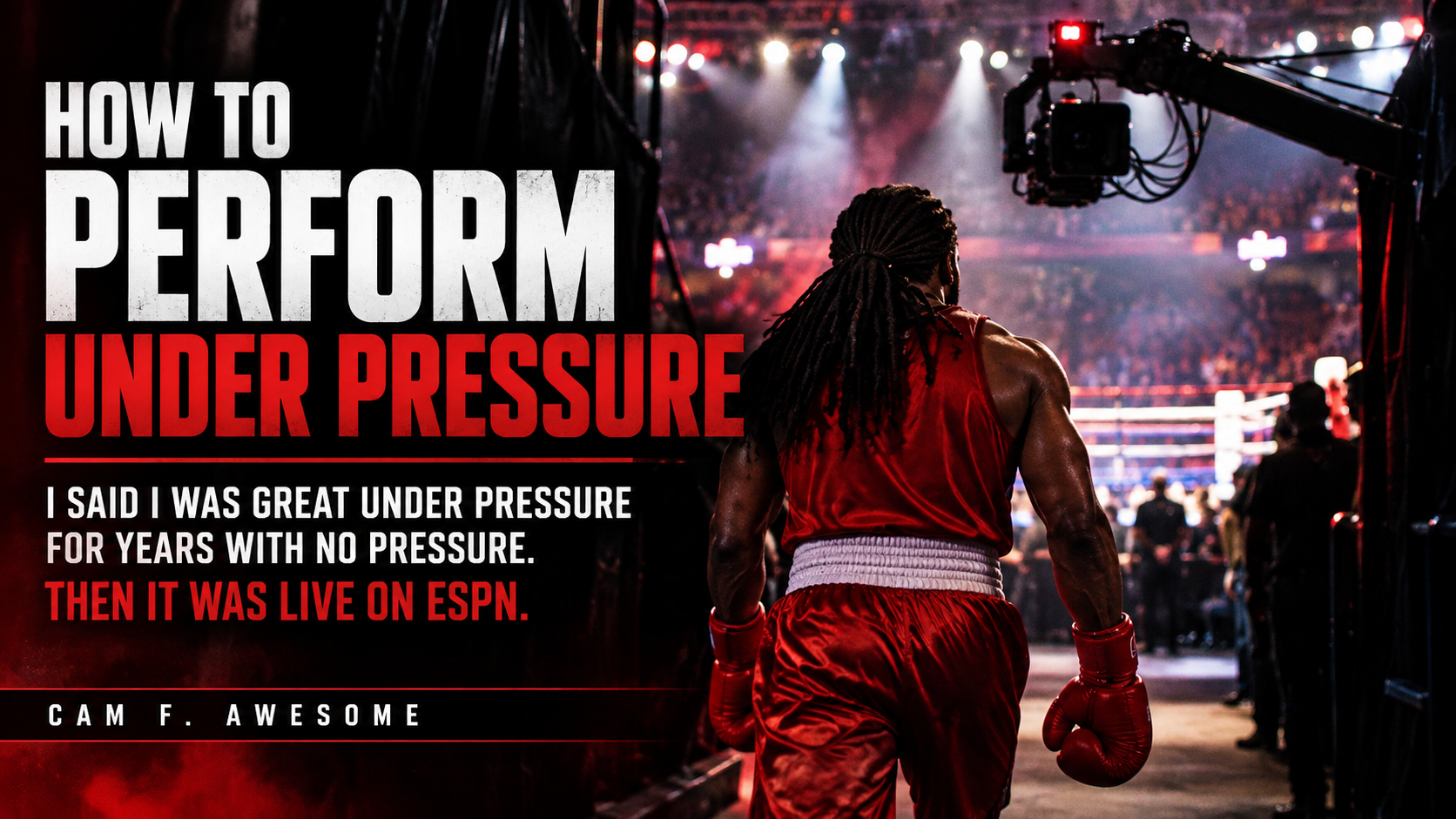
For years, I said "I'm good under pressure" when there was no pressure at all. Rolling dice. Shooting a basketball at a rec center.
Then I was walking to the ring at the 2015 Pan American Games to fight the number one boxer in the world, and a guy said, "Hey, Cam, it's going to be played live on ESPN. No pressure." My response was automatic: "Oh, I'm great under pressure."
That's how to perform under pressure: tell yourself you're the type of person who performs under pressure long before the pressure shows up, then judge yourself on your output instead of the outcome. When the moment finally came, pressure wasn't something foreign to me.
For context: I'm Cam F. Awesome. I legally changed my last name to Awesome, retired as the winningest boxer in USA Boxing history, and captained Team USA. Here's how I built that sentence, the routine I ran on the walk to the ring, what I do when I lose anyway, and how it carries into your next big pitch, presentation, or interview.
Why Saying "I'm Good Under Pressure" Helps You Handle Pressure
Handling pressure starts on ordinary days, with the identity you claim when nothing is on the line.
After the name change, I gave myself some characteristics. I said I was resilient. I said I was ever-evolving. I said I was thorough and paid attention to small details, and I said I was great under pressure.
That last one, I said all the time. If I'm rolling dice or shooting a basketball, I just say, "I'm great under pressure." When I make it, I look cool. When I miss it, who cares? We move on.
But people remember when you say you're good under pressure and then you kill it. So from 2012 on, any time it came up in conversation, I said it, and my friends grew to expect it, like a little corny dad joke. There was never any real pressure.
Then the real thing showed up. I normally fought in a middle school gym in front of 22 people; that night it was 15,000 people, live on national television. I felt comfortable, because I identified as someone who was good under pressure. Once I realized the truth behind that, it changed the way I carried myself and the way I spoke about myself even further.
That's the Identity Loop at work: the story you tell yourself creates an identity, that identity drives your behavior, and the behavior proves the story true. It's the same idea behind one of my mental toughness habits, talking to yourself like you belong before the results say you do.
How to Stay Calm Under Pressure: My Walk-to-the-Ring Routine
Staying calm under pressure, for me, comes down to what I do with my head once the preparation is finished.
When you're walking toward the ring, it's too late to get in more shape. What's going to happen is going to happen. The only thing left that can make a difference is what I think about, so I run the same routine:
Replay the times it worked. I replay all the times I said I was good under pressure and it worked out. If I'm walking to the ring for a big fight, I think about all the other times I walked to the ring for a big fight and ended up winning, and how good it felt. I embody that feeling: I'm that dude who did all those good things.
Exaggerate the ways it can go well. I think about all the ways it could go well, then I exaggerate them until the fight seems easy. Maybe I figure something out right away and keep taking advantage of that one move. Maybe he gets tired easily.
Build no path for the bad version. I have neuropathways for all the ways it can go well, and I don't make any for the ways it can go wrong. I completely ignore the concept that it could go wrong, because it doesn't serve me.
Ask the sentence. What would it look like if I could? That's the sentence.
This isn't a substitute for the training. It's what I do once the training can't change anything.
Output Over Outcome: What to Do When You Lose Under Pressure Anyway
Performing under pressure doesn't mean you always win, and how you treat yourself after a loss decides how you show up for the next one.
Before the ESPN fight, I had another pressure fight against a Canadian boxer. I was literally in his home country, in front of his home crowd, walking to the ring thinking, I'm about to beat this guy up in his own backyard. I won, and it felt good.
But I don't identify with the outcome. I identify with showing up and giving it my all. If I let the win make me feel good, I'd have to let the loss make me feel bad. I'm dope, regardless.
So when I lost the ESPN fight, I did what I do when I'm mad: I asked how I'd wish I reacted in this moment, 10 years from now, and then I let that person drive the car. I could have declined the interview, but the more I say yes to opportunities, the more opportunities I get. I could have kept it real and said the judges were paid off, but keeping it real goes wrong sometimes.
I can't get out of the ring and tell the judge which name to write down. What I control is my output: how I show up, how hard I train, how well I eat and sleep, how focused I am. I've written more about that split in how to bounce back from failure at work. And here's why it matters: if you judge your value on the results, your effort changes.
Here's how that happens:
You make a mistake and punish yourself. You replay it, shrink, and apologize for existing.
You connect that miserable feeling with the attempt itself.
You decide not to attempt anything unless it's perfect.
Perfection is impossible, so you procrastinate.
So if you did everything in your power and still fell short, don't beat yourself up. Celebrate yourself, then give that same effort again next time.
Why wouldn't you? You were celebrated for it, so it was a win in your mind. Think like that over 10 years, through every failure and every decision, and your life is going to be a lot better.
How to Perform Under Pressure at Work: Pitches, Presentations, and Interviews
The same approach works before a big pitch, presentation, or job interview. I use boxing because it's the greatest metaphor for life, but this works for everything.
If you're getting ready for a job interview and you create every reason in your head why you're going to botch it, without giving yourself any ways you'll crush it, you're setting yourself up for failure.
You can create the character for the person you need. Going into a big pitch, presenting, or stepping out of your comfort zone, talk to yourself like the type of person who's able to figure it out, the type of person who gets the outcome you want. Don't think about the outcome you believe is likely. Think about the outcome you actually want, and what it looks like to get there.
The people around you are part of this, too. It's difficult for them to realize you've changed, and some may think you believe you're better than them. Some people think that just because I think I'm awesome, I think any less of them. But there's enough awesome to go around: I think highly of myself, and I think more highly of other people than they usually think of themselves.
If the people around you won't lift you up, find new people. You're not a tree. You can leave.
Here's the whole thing in one place for your next big moment:
Long before: say "I'm good under pressure" in small, low-stakes moments, so the identity isn't new when it counts.
On the walk in: replay the times it went well, picture the version where it's easy, and ask, "What would it look like if I could?"
After: judge yourself on your output, and if you gave everything, celebrate it.
Frequently Asked Questions
What should you tell yourself before a big pitch?
Talk to yourself like the type of person who gets the outcome you want, not the outcome you think is likely. Ask yourself one question: what would it look like if I could? Then judge yourself on your effort, not the result.
Is it bad to imagine everything that could go wrong?
Right before you perform, I think so. When I'm walking to the ring, it's too late to get in more shape, so I build pathways in my head for all the ways it can go well and none for the ways it can go wrong. Thinking about how it could go wrong at that point doesn't serve me at all.
Why does perfectionism lead to procrastination?
Because we punish ourselves after mistakes. We replay them, shrink, and connect that miserable feeling with the attempt itself, so we decide not to try unless it will be perfect. Perfection is impossible, so we put it off. Judging yourself on your effort instead of the outcome breaks that chain.
Are some people just naturally good under pressure?
You can build it. I said "I'm good under pressure" for years when there was no pressure at all, until my friends treated it like a corny dad joke. When I finally walked out to fight the number one boxer in the world, live on ESPN, I felt comfortable because pressure wasn't foreign to me.
Practice the Sentence Before You Need It
Performing under pressure is telling yourself you're the type of person who performs under pressure, and judging yourself on your output. That's the Identity Loop working for you instead of against you, and it's the core of what I teach as a motivational keynote speaker.
So what would it look like if you thought you could? In the big pressure situation coming up in your life, what would it look like if it worked out? And if that picture is unfamiliar, if you've never imagined yourself as the winner, what would it look like if you were the champion in the story you told?
Get Your Team Ready for Its Next Big Moment
Cam F. Awesome brings this message to corporate conferences, sales kickoffs, and association events. If your people tighten up when the stakes rise, in the pitch, the review, or the launch, this keynote shows them how to talk to themselves like people who are good under pressure and how to judge themselves on what they control.
Or call 913-766-3965 or email kelly@upsidespeakers.com to book Cam for your next event.
| Stage | My coward loop (elementary and middle school) | My champion loop (senior year of high school) |
|---|---|---|
| Where the story got told | The walk home after being let out of school 10 minutes early | A 6.4-mile walk to the boxing gym, close to three hours, no iPod |
| Story | I was afraid. I was a coward. I couldn't defend myself. | I was athletic, strong, and resilient. I could beat anyone. |
| Identity | Coward | Champion |
| The question | What does a coward do? | What does a champion do? |
| Behavior | Hide, avoid people, take the long way home, skip the school bathroom, spend lunch in the nurse's office | Show up early, stay late, work harder than everybody, keep going after a loss |
| Result | Every day of hiding kept the story true | Beating boxers I had no business beating, and qualifying for the 2008 Olympic Trials within two years of boxing |
The coward loop
After a bully slammed my head into a brick wall and put me in the hospital with a concussion, my school's solution was to release me at 2:50, ten minutes early, so I could get home before he got to me. That walk is where I started telling myself the story of why I was leaving early: I was afraid, I was a coward, I couldn't defend myself. Then I played that character's role to a T, anxiously avoiding a fight that didn't happen until my first week of high school.
The champion loop
My senior year, my family moved from New York to Florida, and my boxing gym was 6.4 miles from my high school. No iPod, close to three hours stuck with my thoughts. I figured if I was going to be the author of the story, I was going to make myself the hero: all the money, all the cars, all the championship belts. None of it was true.
Then I noticed a direct correlation between how highly I spoke about myself on the way to the gym and how well I performed once I got there. Three hours a day, five days a week, I was telling myself I was unstoppable. I created a feedback loop of confidence.
There were times I'd be fighting a tough opponent and I'd want to be scared. But in my head it was, "Oh no, I'm the champion. I can't be scared. This is just a walk in the park for me." That allowed me to conduct myself like the champion I thought I was.
Whatever your story is, you've heard it so often that it stops sounding like a story and starts feeling like truth. I break down the rest of that mindset in how to build a championship mindset.
How Self-Talk Affects Performance: My Teammate and the Kid With Tattoos
I've watched self-talk decide a fight from outside the ring. Around the same time I was making that walk, my teammate, who was 16, was matched with a 16-year-old opponent who had tattoos. Before the fight, he came to me convinced the kid across the ring was a grown man: tattoos at 16, so "that boy's a man."
He was more talented than I was. He lost a fight he could have easily won, because he told himself a story: he couldn't beat the 16-year-old with tattoos. Once "that boy's a man" was the story, the rest of the loop only had one job, which was to prove it.
Look at the contrast. Same stretch of time, and I was the less talented one, walking three hours a day telling myself I was unstoppable, beating boxers I had no business beating. He had more talent and a worse story.
We all do some version of it. So what's the story you've been telling lately?
It can be real simple: I'm too old to start over. People like me don't get good opportunities. I'm not good with money.
Map Your Own Loop Tonight: An Exercise for Finding Your Self-Limiting Beliefs
You can map your own Identity Loop tonight with a sheet of paper and four steps. The first two show you the loop you're in; the last two start the one you want.
Step 1: Write down every "I can't"
Make a list of everything you'd say in conversation about what you can and can't do, and focus on the can'ts. Things like "I could never do that," "I'm afraid of spiders," "I could never get a promotion," or "I'm not the type to do ___." List everything you've said about what you are and aren't capable of. That list is your self-limiting stories.
Step 2: Wake up 10 years from now
Picture this: you wake up 10 years from now exactly where you want to be. You have the money in your bank account, the position, the title, whatever it is you want. Write out everything you have and what your life looks like.
Step 3: Ask the question I asked at 17
Go back to your list from Step 1 and ask, line by line: what would it look like if I thought I could? Henry Ford said, "Whether you think you can or you think you can't, you're right." At 17, that question meant ignoring my current circumstances to speak my future into existence. By definition, I had to be delusional, and I'm grateful for that delusion.
Step 4: Ask what that person would do now
Give the person in Step 2 an identity, then ask the question I asked when I started playing the role of a champion: what would they do now? How would they carry themselves? Whatever you write down is the behavior that proves the new story true.
Where to Break the Loop: How to Change Your Self-Talk When New Habits Won't Stick
Most people try to break the Identity Loop at Behavior. In 2012, so did I.
That year, I became the first boxer in United States history to be suspended and kicked off the Olympic team for not filling out paperwork. I gained 60 pounds. When it was time to come back, I'd hit the gym for a few days and fall off, start again and fall off, over and over.
One day I looked in the mirror and said, "You idiot. You fat loser. How did we get here?" In that moment I realized there was a difference between me in 2012 and the me that walked to the gym in high school. One of us liked me.
I had created the identity of an inconsistent person, and an inconsistent person starts, stops, quits, and repeats. So many of us think if we change our behavior enough, it will change our identity. I don't believe it works like that. Create the new identity first, and you'll create the behavior that leads to a new story.
So I spent $178, went to City Hall, and legally changed my last name to Awesome. I did not feel awesome when I did it. I was depressed and struggling, but I figured if I changed the way I talked to myself, it would change my identity. (I also needed people to show up for me first, which I wrote about in how to turn failure into success.)
Then I made it public. When I made it public, it held me accountable. On my half birthday, I threw what I called an after birthday party to celebrate the death of the old me and the birth of the new me. I reintroduced myself with three identity statements: I am resilient, I cross my T's and dot my I's, and I'm good under pressure.
Here's how I knew it took. In 2015, I fought the number one boxer in the world at the time, a Cuban fighter, in the semifinals of the Pan American Games, live on ESPN. I'd been telling myself and other people I was good under pressure for so long that it was automatically in my nervous system: "Oh no, I'm great under pressure." The bell rang and I gave it everything I had, even though they didn't say my name when the winner was announced.
The story you tell yourself doesn't have to be true. You just have to believe it long enough for your identity to take hold.
Frequently Asked Questions
Can negative self-talk hurt your performance?
Yes, because negative self-talk doesn't stay talk. In the Identity Loop, the story you tell yourself becomes your identity, and the identity drives your behavior. I watched a more talented teammate lose a fight he could have easily won after deciding his 16-year-old opponent was "a man" because he had tattoos.
Does the story you tell yourself have to be true?
No. It doesn't have to be true; you just have to believe it long enough for your identity to take hold. When I was walking to the gym in high school telling myself I had all the championship belts, none of it was true yet. Within two years of boxing, I had qualified for the 2008 Olympic Trials.
Why can't I stick to new habits?
Often it's because the identity underneath the habit hasn't changed. After my 2012 Olympic suspension, I saw myself as an inconsistent person, so I would start, stop, quit, and repeat at the gym. Changing the behavior didn't change the identity; claiming a new identity first is what changed the behavior.
Tell Yourself a Better Story
Self-talk shapes success because the story comes first: it builds the identity, the identity chooses the behavior, and the behavior proves the story. That's the Identity Loop, and it's the core of what I teach as a motivational keynote speaker. You can't rewrite past chapters, but you do have the ability to write the next one.
I don't know who criticized you so often that their voice slowly became yours. But you don't have to be mean to you. It's free to be nice to yourself. So tell yourself a better story.
Help Your Team Tell Itself a Better Story
Cam F. Awesome brings the Identity Loop to corporate conferences, sales kickoffs, and association events. If your people have quietly decided what they can't do, this keynote shows them the story behind that belief and how to start writing the next chapter.
Or call 913-766-3965 or email kelly@upsidespeakers.com to book Cam for your next event.