
How Self-Talk Shapes Success: The Story You Tell Yourself Becomes Your Results
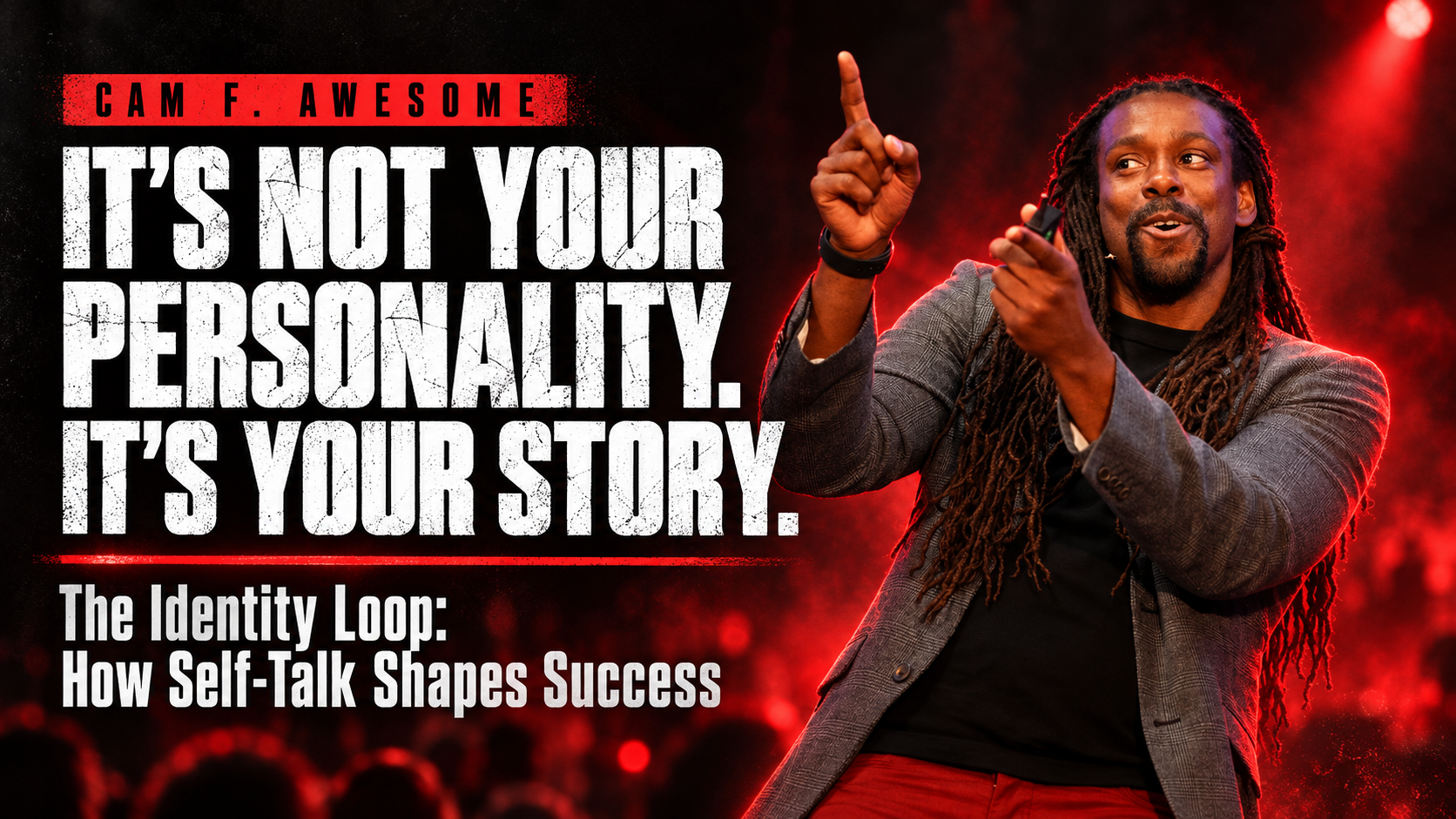
"Cameron, you see the dude I'm fighting? He got tattoos. Can you even have tattoos at 16? That boy's a man."
That was my teammate, 16 years old, talking about an opponent his own age. He was more talented than I was. I watched him lose a fight he could have easily won, because he told himself a story.
That is how self-talk shapes success. The story you tell yourself creates an identity, that identity drives a behavior, and the behavior has to prove the original story true. I call it the Identity Loop, and it runs in every room you walk into.
I'm Cam F. Awesome, the winningest boxer in USA Boxing history, a 12-time national champion, and a former captain of Team USA. I've lived this loop in both directions: as a bullied kid who believed he was a coward, and as a high school boxer who talked himself into becoming a champion. Here's the loop, stage by stage, my two versions of it, and how to map and break your own.
The Identity Loop: Four Stages You Can Draw
The Identity Loop explains how self-talk shapes success, one stage at a time. Draw a circle and put four words around it: Story, Identity, Behavior, Result. Arrows run clockwise from each word to the next, and the last arrow runs from Result back to Story.
Stage 1: The Story
Every moment of the day, in every room we walk into, we're telling ourselves a story about who we are, what we're capable of, and what we deserve. Most people aren't conscious of it. A lot of the time, it's a story someone gave us years ago: they told us we weren't smart enough or capable, and we carried that story on long after they were gone.
People believe the story they tell themselves is their personality and their abilities. So they say things like "I can never lose the weight," "I'm not good with technology," or "I can't figure out AI." That's not your personality. It's your story.
Stage 2: The Identity
The stories we tell create an identity, and we believe we are that identity. As people, we have an amazing ability to tell ourselves a story and then play that character's role to a T.
Stage 3: The Behavior
The identity drives a behavior. Next to this stage, write the question the identity answers for you: what does a ___ do? I asked it as a coward and as a champion, and both times the answer told me how to act.
Stage 4: The Result
That behavior has to prove the original story true, so you can keep telling the story. It's the only way the cycle continues.
It doesn't stay in your head, either. I walk into a lot of rooms where people don't look like me. I'm Black, and I could tell myself nobody in that room thinks I belong there, which is completely in my head.
But then when I talk to you, I'm kind of standoffish. You feel it, you don't know why, and you give it back to me. And I walk away thinking, "See, I knew they didn't think I belonged here."
The Story You Tell Yourself, Two Ways: My Coward Loop and My Champion Loop
I've run the Identity Loop in both directions, through the same four stages, in two eras of my life.
| Stage | My coward loop (elementary and middle school) | My champion loop (senior year of high school) |
|---|---|---|
| Where the story got told | The walk home after being let out of school 10 minutes early | A 6.4-mile walk to the boxing gym, close to three hours, no iPod |
| Story | I was afraid. I was a coward. I couldn't defend myself. | I was athletic, strong, and resilient. I could beat anyone. |
| Identity | Coward | Champion |
| The question | What does a coward do? | What does a champion do? |
| Behavior | Hide, avoid people, take the long way home, skip the school bathroom, spend lunch in the nurse's office | Show up early, stay late, work harder than everybody, keep going after a loss |
| Result | Every day of hiding kept the story true | Beating boxers I had no business beating, and qualifying for the 2008 Olympic Trials within two years of boxing |
The coward loop
After a bully slammed my head into a brick wall and put me in the hospital with a concussion, my school's solution was to release me at 2:50, ten minutes early, so I could get home before he got to me. That walk is where I started telling myself the story of why I was leaving early: I was afraid, I was a coward, I couldn't defend myself. Then I played that character's role to a T, anxiously avoiding a fight that didn't happen until my first week of high school.
The champion loop
My senior year, my family moved from New York to Florida, and my boxing gym was 6.4 miles from my high school. No iPod, close to three hours stuck with my thoughts. I figured if I was going to be the author of the story, I was going to make myself the hero: all the money, all the cars, all the championship belts. None of it was true.
Then I noticed a direct correlation between how highly I spoke about myself on the way to the gym and how well I performed once I got there. Three hours a day, five days a week, I was telling myself I was unstoppable. I created a feedback loop of confidence.
There were times I'd be fighting a tough opponent and I'd want to be scared. But in my head it was, "Oh no, I'm the champion. I can't be scared. This is just a walk in the park for me." That allowed me to conduct myself like the champion I thought I was.
Whatever your story is, you've heard it so often that it stops sounding like a story and starts feeling like truth. I break down the rest of that mindset in how to build a championship mindset.
How Self-Talk Affects Performance: My Teammate and the Kid With Tattoos
I've watched self-talk decide a fight from outside the ring. Around the same time I was making that walk, my teammate, who was 16, was matched with a 16-year-old opponent who had tattoos. Before the fight, he came to me convinced the kid across the ring was a grown man: tattoos at 16, so "that boy's a man."
He was more talented than I was. He lost a fight he could have easily won, because he told himself a story: he couldn't beat the 16-year-old with tattoos. Once "that boy's a man" was the story, the rest of the loop only had one job, which was to prove it.
Look at the contrast. Same stretch of time, and I was the less talented one, walking three hours a day telling myself I was unstoppable, beating boxers I had no business beating. He had more talent and a worse story.
We all do some version of it. So what's the story you've been telling lately?
It can be real simple: I'm too old to start over. People like me don't get good opportunities. I'm not good with money.
Map Your Own Loop Tonight: An Exercise for Finding Your Self-Limiting Beliefs
You can map your own Identity Loop tonight with a sheet of paper and four steps. The first two show you the loop you're in; the last two start the one you want.
Step 1: Write down every "I can't"
Make a list of everything you'd say in conversation about what you can and can't do, and focus on the can'ts. Things like "I could never do that," "I'm afraid of spiders," "I could never get a promotion," or "I'm not the type to do ___." List everything you've said about what you are and aren't capable of. That list is your self-limiting stories.
Step 2: Wake up 10 years from now
Picture this: you wake up 10 years from now exactly where you want to be. You have the money in your bank account, the position, the title, whatever it is you want. Write out everything you have and what your life looks like.
Step 3: Ask the question I asked at 17
Go back to your list from Step 1 and ask, line by line: what would it look like if I thought I could? Henry Ford said, "Whether you think you can or you think you can't, you're right." At 17, that question meant ignoring my current circumstances to speak my future into existence. By definition, I had to be delusional, and I'm grateful for that delusion.
Step 4: Ask what that person would do now
Give the person in Step 2 an identity, then ask the question I asked when I started playing the role of a champion: what would they do now? How would they carry themselves? Whatever you write down is the behavior that proves the new story true.
Where to Break the Loop: How to Change Your Self-Talk When New Habits Won't Stick
Most people try to break the Identity Loop at Behavior. In 2012, so did I.
That year, I became the first boxer in United States history to be suspended and kicked off the Olympic team for not filling out paperwork. I gained 60 pounds. When it was time to come back, I'd hit the gym for a few days and fall off, start again and fall off, over and over.
One day I looked in the mirror and said, "You idiot. You fat loser. How did we get here?" In that moment I realized there was a difference between me in 2012 and the me that walked to the gym in high school. One of us liked me.
I had created the identity of an inconsistent person, and an inconsistent person starts, stops, quits, and repeats. So many of us think if we change our behavior enough, it will change our identity. I don't believe it works like that. Create the new identity first, and you'll create the behavior that leads to a new story.
So I spent $178, went to City Hall, and legally changed my last name to Awesome. I did not feel awesome when I did it. I was depressed and struggling, but I figured if I changed the way I talked to myself, it would change my identity. (I also needed people to show up for me first, which I wrote about in how to turn failure into success.)
Then I made it public. When I made it public, it held me accountable. On my half birthday, I threw what I called an after birthday party to celebrate the death of the old me and the birth of the new me. I reintroduced myself with three identity statements: I am resilient, I cross my T's and dot my I's, and I'm good under pressure.
Here's how I knew it took. In 2015, I fought the number one boxer in the world at the time, a Cuban fighter, in the semifinals of the Pan American Games, live on ESPN. I'd been telling myself and other people I was good under pressure for so long that it was automatically in my nervous system: "Oh no, I'm great under pressure." The bell rang and I gave it everything I had, even though they didn't say my name when the winner was announced.
The story you tell yourself doesn't have to be true. You just have to believe it long enough for your identity to take hold.
Frequently Asked Questions
Can negative self-talk hurt your performance?
Yes, because negative self-talk doesn't stay talk. In the Identity Loop, the story you tell yourself becomes your identity, and the identity drives your behavior. I watched a more talented teammate lose a fight he could have easily won after deciding his 16-year-old opponent was "a man" because he had tattoos.
Does the story you tell yourself have to be true?
No. It doesn't have to be true; you just have to believe it long enough for your identity to take hold. When I was walking to the gym in high school telling myself I had all the championship belts, none of it was true yet. Within two years of boxing, I had qualified for the 2008 Olympic Trials.
Why can't I stick to new habits?
Often it's because the identity underneath the habit hasn't changed. After my 2012 Olympic suspension, I saw myself as an inconsistent person, so I would start, stop, quit, and repeat at the gym. Changing the behavior didn't change the identity; claiming a new identity first is what changed the behavior.
Tell Yourself a Better Story
Self-talk shapes success because the story comes first: it builds the identity, the identity chooses the behavior, and the behavior proves the story. That's the Identity Loop, and it's the core of what I teach as a motivational keynote speaker. You can't rewrite past chapters, but you do have the ability to write the next one.
I don't know who criticized you so often that their voice slowly became yours. But you don't have to be mean to you. It's free to be nice to yourself. So tell yourself a better story.
Help Your Team Tell Itself a Better Story
Cam F. Awesome brings the Identity Loop to corporate conferences, sales kickoffs, and association events. If your people have quietly decided what they can't do, this keynote shows them the story behind that belief and how to start writing the next chapter.
Or call 913-766-3965 or email kelly@upsidespeakers.com to book Cam for your next event.