
Leadership Lessons From Boxing: What the Ring Teaches About Leading
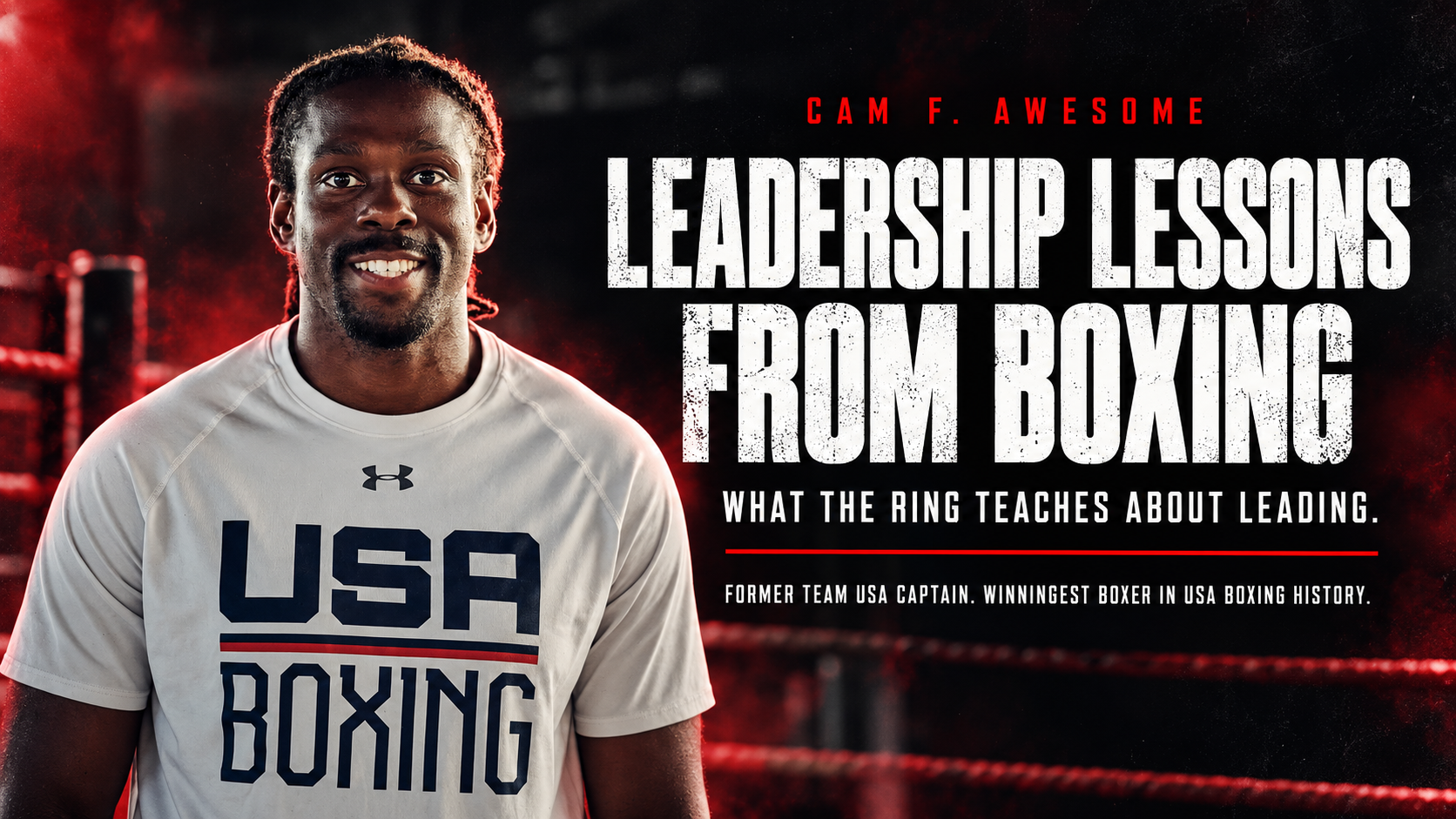
What does boxing teach you about leadership? That being in charge and leading a team are two completely different jobs, and most people never notice the difference, because being in charge feels good. I am Cam F. Awesome, the winningest boxer in USA Boxing history, a 12-time national champion, a former captain of Team USA Boxing, and the guy from the Netflix documentary Counterpunch. These are the leadership lessons from boxing I actually learned, including the ones that cost me something.
Here is the part I usually skip when I introduce myself. I was 18 or 19 years old when I was named captain of Team USA. I had never made a team before in my life. The first team I was ever a part of was a team I was captain of.
The first leadership lesson from boxing: being in charge is not leading
I do not like people telling me what to do. So by default, I always end up in charge. For years I assumed that because I was comfortable being in charge, I was good at leading. That is not a qualification. That is a personality trait.
I am not a man of prayer. I am a man of punctuality. So when practice started at 4:00 p.m. and my teammates wanted to pray together as a team, my rule was simple: if you want to pray, show up at 3:55 and pray then. When you are on my clock, we work.
Here is what I understand now that I did not understand at 19. There was no hard stop at the end of that workout. Nobody was kicking us out of the gym. I could have given my team 45 seconds to pray together, come out of it more united, more grounded in what they believed, and gotten a better workout out of the deal. I took 45 seconds away from my teammates to protect a schedule that did not need protecting.
That is the whole lesson in one sentence: I optimized for the task and ignored the team. When I came back to the team at 24 or 25, I made time for things like that. Same guy, same standards, different understanding of the job.
What a Team USA captain actually does: leadership lessons from sports that transfer
People hear "captain of Team USA" and picture a pep talk. The real job was administrative, cultural, and occasionally uncomfortable.
My actual responsibilities:
Making sure every member of the team made weight
Making sure they got to practice on time and obeyed curfew
Answering to the coaches when someone snuck out of their room in a foreign country, missed a workout, or got drunk
Delivering the punishment to my own teammates after I got in trouble for what they did
Researching the culture of every country we competed in, then briefing the team so we did not embarrass ourselves or the United States
That last one became my favorite part of the job. We would go to Azerbaijan, Kazakhstan, Ukraine, places where the rules are not the rules we grew up with. In some countries you do not tip. In some countries you do not look your elders in the eyes. I would do the research, learn how to say hello, goodbye, thank you, and where is the bathroom, then teach it to the team in our group chat.
I represented Team USA in over 30 countries. What that job taught me had nothing to do with punching. It taught me how many different ways people can be right about how to live, and how similar we all are underneath the differences. If you lead a distributed team, a multi-generational team, or a team that spans a merger, that is the same skill with a different passport.
Leadership lessons from athletes: take the 2 percent and leave the rest
People ask me who the best leader I had in boxing was. I cannot name one, because I take different traits from different people.
Jeremiah Graziano was a boxer one year older than me. He won nationals in 2008 at heavyweight the same year I won super heavyweight, and we trained together every day. He walked into the gym at 100 percent. No hellos, no small talk, no slow warmup, just work until complete exhaustion. Sparring him was like a championship fight four or five times a week, which meant actual fights felt like a relief. I did not want to be Jeremiah in every way. I took his intensity and I left the rest.
John Brown was my coach for most of my career and the man who built the boxing equipment company Ringside. He did not teach me much about boxing. He taught me how to use connective tissue between people, how to work the politics of a sport, and how to get the outcome you want with almost no resources and a lot of creativity.
My father was an entrepreneur, and he was exceptional at organizing talented people. I built my entire business on that one skill of his. Everyone around me is smarter than me. My manager, my business coach, my therapist, my dietitian, the people who help me with this blog. That is the trick. My dad was also terrible at collecting money, so I took the organizing and left that part behind.
Here is the counterintuitive part. When somebody gives you advice, throw away 98 percent of it. Most of it does not apply to your life, your situation, or where you are trying to go. But that 2 percent is a jackpot. A lot of people will not take a meeting unless they expect more than a 2 percent return, and they are leaving the best leadership education available on the table. The 98 percent you discard is valuable too, because now you know exactly what not to do.
The leadership mistake that cost me something
My mother recently passed away. Because I am a leader, because I am good under pressure, because I am comfortable running things, I assumed I should be the one to plan her funeral. My sister ended up doing it. We butted heads over it, and I eventually put my hands in the air and let her have it, fully expecting to watch it go badly.
I flew to England for the funeral a few days ago. The wake, the service, the repast, the gathering afterward, all of it was put together better than I could have done it. She thought of details I never would have considered. She knew more about our family's culture than I did and she built the whole thing around that knowledge.
It cost me something with my sister, and I am still working on that. The lesson underneath it is one every leader I know has had to learn at least once: sometimes another person is better equipped and better prepared for the mission than you are. Your job is to step back and let them succeed, or sometimes let them fail and learn from it. If you are overbearing and you take over everything, nobody else on your team ever gets the chance to learn, grow, or make the mistake that teaches them.
Business lessons from boxing: the toughest fighter usually is not the one who wins
This is the leadership principle from boxing that companies get wrong most often.
Walk into any gym and people will point at the biggest, hardest, most intimidating guy and tell you he is going to win. He usually does not. We have a saying in the sport: heart will get you hurt. Toughness gets you to a certain level and then it stops working. It is often the guy without the muscles, the unassuming guy, the happy guy, who turns out to be the actual monster.
Companies make the identical mistake. They spend big money on what everyone agrees is cool. But cool does not mean effective, and exciting does not mean effective. The boring, monotonous, unexciting things are usually what wins.
That is my TNT list, things that take no talent. Showing up early. Mastering the fundamentals. Giving full effort. Bringing enthusiasm. None of that requires natural ability, and all of it is available to every single person on your team today. It is the same principle behind how to build a championship mindset, and it is why I retired as the most decorated boxer in USA Boxing history without ever being the most talented man in the room.
In leadership we assume the loudest person should run the room and the biggest muscles should win the fight. In my experience the person who should be leading is the one who understands the process best, the most patient person in the room, and the smartest person in the room, and those are rarely the same person as the loudest.
This connects directly to the Identity Loop, the framework I teach as a corporate keynote speaker. The story you tell yourself creates your identity, your identity drives your behavior, and your behavior goes looking for proof that the original story was true. I told myself I was the leader, so I behaved like the only person qualified to lead, so I collected evidence that nobody else could do it. The loop runs on teams exactly the way it runs on individuals.
Frequently Asked Questions
What does boxing teach you about leadership?
Boxing teaches that being in charge and leading are different jobs. In the ring you are accountable for outcomes you do not fully control, which forces you to focus on preparation, process, and the people in your corner rather than on authority. It also teaches that the toughest competitor rarely wins, because toughness stops working at a certain level.
What makes a good team captain?
A good team captain handles the unglamorous work nobody sees: accountability, logistics, standards, and absorbing the consequences when teammates fall short. As captain of Team USA Boxing I was responsible for weight, curfew, punctuality, and briefing the team on the culture of every country we entered. The title is not the job. The job is the job.
Do leadership lessons from sports actually apply to business?
They apply when the underlying mechanic transfers, not when the metaphor sounds good. Enforcing standards, taking the useful 2 percent from every mentor, and stepping aside for someone better prepared are all team mechanics, not sports mechanics. Anything that only works because there is a scoreboard does not transfer.
What did Cam F. Awesome learn as captain of Team USA Boxing?
That he was a bad leader at 19 and did not know it. He cut a team prayer short to protect a workout clock that did not need protecting, and it took years to understand that 45 seconds of unity would have produced a better session than 45 seconds of training. He also learned, from competing in over 30 countries, how to lead people whose norms are nothing like his own.
The corner is the point
Boxing is the greatest metaphor for leadership because of what happens between rounds. The bell rings, you go back to your corner, and people hand you water, ice, and advice. A leader's real job is to build that corner for other people, and then to be quiet enough to let someone else sit in the chair when they are better suited to the fight.
I learned that by getting it wrong first, at 19, with a team I had no business captaining. The Identity Loop is what I use to explain why: the story I told myself about being the leader shaped every behavior that followed, right up until my sister planned a funeral better than I ever could have.
Bring These Leadership Lessons to Your Next Conference
Cam F. Awesome brings this material to leadership summits, sales kickoffs, association meetings, and corporate conferences. If your managers confuse authority with leadership, hold onto work that belongs to someone else, or reward the loudest person in the room, this keynote gives them a practical way to see the pattern and interrupt it. Book Cam as your motivational keynote speaker for corporate events.