
How to Build a Championship Mindset
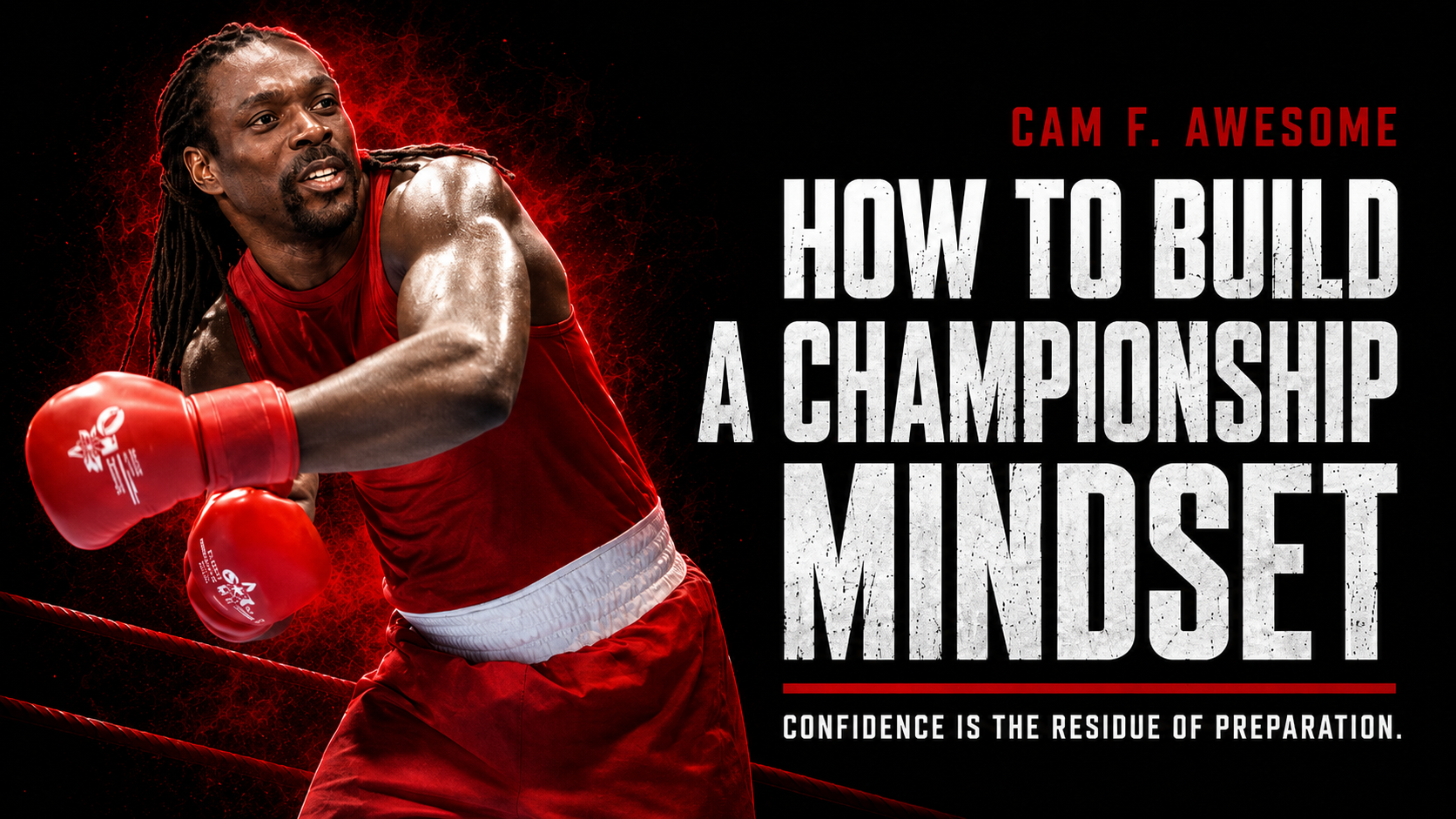
How to Build a Championship Mindset
How do you build a championship mindset? You build it long before the moment that tests it. A championship mindset is not confidence you summon when you walk into the room. It is the residue of preparation nobody saw: the reps, the work, and the way you talk to yourself in the silence when no one is watching. Here is how I built mine from scratch, and why the usual advice to "just believe in yourself" gets the order backward.
I am Cam F. Awesome, the winningest boxer in USA Boxing history, a 12-time National Champion, 3-time Olympic Trials Champion, and former Captain of Team USA. I was not a naturally gifted athlete. I was the kid who got beat up in ninth grade and did not make a single team until 11th grade. Everything I built, I built on purpose, one unglamorous rep at a time.
This post breaks down the exact mental architecture behind that mindset: the self-talk, the daily routine, my counterintuitive relationship with hard work, and how to hold your belief together when it cracks mid-competition. If you lead a team, sell, compete, or perform under pressure, this is a blueprint you can copy.
A Championship Mindset Starts Before You Walk Into the Room
By the time I walk into the fight, or the room, or the stage, it is too late to change the outcome. My confidence in that moment does not come from a pep talk. It comes from what I already did.
Once you walk into that room, it is too late to do anything about anything. The reason I walk in with all the confidence in the world is that I did the things most people are not willing to do. I know I walked the six miles to the gym. I know I trained through the holidays when other people went home. That is the whole difference, and I do not even have to say it out loud. When I carry myself that way, everybody in the room already knows.
The self-talk that separates a champion from someone who is only hoping is not louder positive thinking. It is evidence. My confidence is not a feeling I generate on the spot. It is a conclusion I earned in the weeks before anyone was watching.
Bank the reps first, then draw confidence from them. The belief is downstream of the work, never a substitute for it.
It is not about the room at all. It is about what you did before the room. It is preparation.
Do not hope. Prepare so well you expect it. When I have done everything to prepare, I am not hoping I win. I expect to.
I carry the same logic from boxing into speaking. I know how many times I have rehearsed my keynote, how many stages I have touched, how much I lived out of a van to build this career. So when I walk on, the belief is already settled. This is the front end of my Identity Loop framework: the story you tell yourself creates your identity, and your identity drives your behavior.
How to Build Confidence Before You Have Results
Here is the hard part nobody tells you: at the start, the belief is not true yet. I was not a gifted athlete. I had no results to point to. So how do you talk to yourself like a champion before you are one?
My answer is simple: the gap between believing it and it being true is suffering. I believed it because I suffered, because things were hard, and because I kept going anyway. The more discomfort I could tolerate in training, the more comfortable competition time became.
So I stopped treating the hard part as a punishment and started treating it as a choice. Because here is the truth: you are going to suffer either way. You can suffer inside a life you did not choose, or you can suffer to build the one you want. Both scenarios cost you. But I choose my suffering, and that changes everything.
Choose your suffering. I either suffer living a life I do not want, or I suffer and get the life I do want. Both roads ask something of me, so I choose the one that pays me back.
Do the reps in front of people who are better than you. I got in the ring with people I knew were better than me because I was going to learn something, even if it came with some embarrassment.
Let the belief become true through evidence. The work and the suffering are up front. The results come after. And results are what turn a story you are telling yourself into confidence you actually own.
The turning point came when I stopped looking up at everyone in the gym and noticed people starting to look up at me. Here is something I learned along the way: being naturally gifted can actually be a curse. People who are good at something without working for it never learn to push through the hard part, so when tough times show up, they are talented novices. I was not the most gifted, but I became an expert. That is the same principle I teach in how to turn failure into success: your output builds your identity, not the other way around.
The Daily, Unglamorous Routine Behind a Championship Mindset
A championship mindset is not built in the highlight reel. It is built in the parts nobody wants to film. When I tell other speakers my actual routine, they think I am joking, until I show them the voice memos.
When it comes to speaking, I run my full hour keynote, start to finish, at least once a day. I record every run and tighten the transitions, cut the weak spots, sharpen the timing. That is the part most people do not want to do. Then they watch me get a standing ovation and they want that, but the standing ovation is just the visible half of the work nobody saw.
My daily reps are deliberately boring:
A full rep, every day. The entire keynote, start to finish, no shortcuts. In boxing, the whole session, every time.
A morning walk with intentional self-talk. Every morning I start with an iced coffee and a two-mile walk, and I talk to myself like a winner, reminding myself of the work I have already banked.
Accountability with real stakes. I hold myself to what I said I would do, and I treat slipping as a genuine cost, not a shrug.
There is a hard edge to this, and I am honest about it. I do not let myself off easy. During my years in Kansas City, I sparred a fighter far more dangerous than most of my actual opponents, every single day, and he never once knocked me out in all those years. So when fight night came, it almost felt like a day off. The person across from me was not as tough as the person I trained with at home. The harder you work before game time, the easier game time becomes. The unglamorous routine is not the price of the mindset. It is the mindset.
The Most Common Way People Sabotage Their Own Mindset
Most people lose before they start, and they do it with their own self-talk. I watched it happen in real time, and it is the clearest lesson in my whole keynote.
My more talented teammate, a 16-year-old, was matched against another 16-year-old who happened to have tattoos. My teammate psyched himself out before the bell. "You see the guy I'm fighting? He's got tattoos. That's a grown man." Then I watched him lose a fight he could have easily won, because he told himself a story he could not beat.
We all do some version of that. As people, we have an amazing ability to tell ourselves a story and then play our character's role to a T. If the story you tell yourself is that you are not smart enough, not ambitious enough, or that you will never figure it out, you will play that part perfectly.
The self-sabotage shows up in a few predictable places:
Making yourself the punchline. Shrinking your own self-talk to make other people comfortable.
Staying in rooms that do not challenge you. It feels good to be the best one there, but nobody in that room is forcing you to grow. Surround yourself with people who make you the best version of yourself, even when it is inconvenient.
Confusing entertainment for information. If you have not taken any real action based on something you watched on the news in the last seven days, it was not information. It was entertainment.
Comparing yourself to a highlight reel. Online, you are measuring your real life against something that is often staged: the rented cars, the borrowed clothes, the numbers that are not real. That is a fight you cannot win, because the other side is not real.
My fix is to be intentional about your inputs and your circle. Spend your time with people who lift you up and hold you accountable. And when the people around you keep writing a different story over the one you are building, it is okay to keep your business to yourself until it takes root.
How to Rebuild a Championship Mindset When It Cracks Mid-Competition
Here is the counterintuitive truth: you cannot rebuild your mindset in the moment it cracks. That moment is already lost. What saves you is the work you did on your self-talk long before you ever needed it.
When your mindset cracks, there is not much you can do in that exact moment. That moment is gone. It is what you did before that moment that carries you.
The clearest example is my ESPN interview after I lost to a Cuban fighter at the Pan American Games, live in front of 15,000 people and a national TV audience. Instead of trashing the judges or my opponent, I gave an interview where I refused to say a single negative thing about myself. That was not a decision I made after the loss. I did not just start talking to myself like that after I lost. I talked to myself like that when I was winning, and in the quiet times, and while I was training. So by the time I needed it, it was already wired in.
When a plan is falling apart in real time, I do have a sequence, and it only exists because of years of preparation:
Run your plan. Execute what you trained to do.
Adjust and disrupt. If the plan is not working, shift your focus to breaking your opponent's rhythm instead of forcing your original approach.
Test the tank. As a last resort, raise the intensity until one of you breaks first. That option only works if you prepared well enough to trust what is in your tank.
The through-line is that none of those recovery options exist without the preparation behind them. A champion mindset in a crisis is not improvised. It is withdrawn from an account you spent years filling.
Frequently Asked Questions
How do you build a championship mindset when you're not naturally talented?
You build it through consistent work and reps, not talent. I was not a gifted athlete, but I outworked more talented boxers by doing the uncomfortable things they avoided. I have actually come to believe natural talent can be a curse, because gifted people never learn to push through the hard part. I was not naturally gifted, but I became an expert.
What self-talk builds a championship mindset?
Evidence-based self-talk, not empty affirmation. A champion reminds themselves of the specific work they did that others did not, which turns confidence into a conclusion instead of a hope. I do this on a daily two-mile walk, talking to myself like a winner by reviewing the reps I have already banked.
What are things that take no talent?
My TNT list, "Things that take No Talent," includes showing up early, giving full effort, asking good questions, and being consistent. These require zero natural ability, and I credit them for making me the winningest boxer in USA Boxing history. Anyone can do them, which is exactly why they build a championship mindset.
How do you stay confident under pressure?
You make confidence automatic before the pressure ever arrives. I told myself and others I was good under pressure for years, so by the time the biggest fight of my life came, the response was already part of my nervous system. You cannot install it in the moment. You install it in the quiet times.
How do people sabotage their own mindset?
The most common way is telling yourself a story you cannot win, before you even start. People also self-sabotage by shrinking to make others comfortable, staying in rooms that do not challenge them, and comparing themselves to highlight reels that are not real.
The Story You Tell Yourself Determines the Rest
A championship mindset is not a gift and it is not a mood. It is the compounding result of the work you do before anyone is watching and the way you talk to yourself in the silence. The confidence is downstream. The reps come first
That is the front half of my Identity Loop: the story you tell yourself creates your identity, and your identity drives the behavior that produces your results. Change the story, do the work, and the mindset takes care of itself.
Bring the Championship Mindset Keynote to Your Next Conference
I deliver my keynote Becoming Awesome to corporate conferences, association events, and leadership summits nationwide as a resilience and mindset keynote speaker. If your team is talented but inconsistent, plays it safe under pressure, or lets setbacks kill momentum, this keynote gives them a repeatable method for building confidence through preparation, self-talk, and the things that take no talent.