
How to Turn Failure Into Success: The Identity Loop Framework
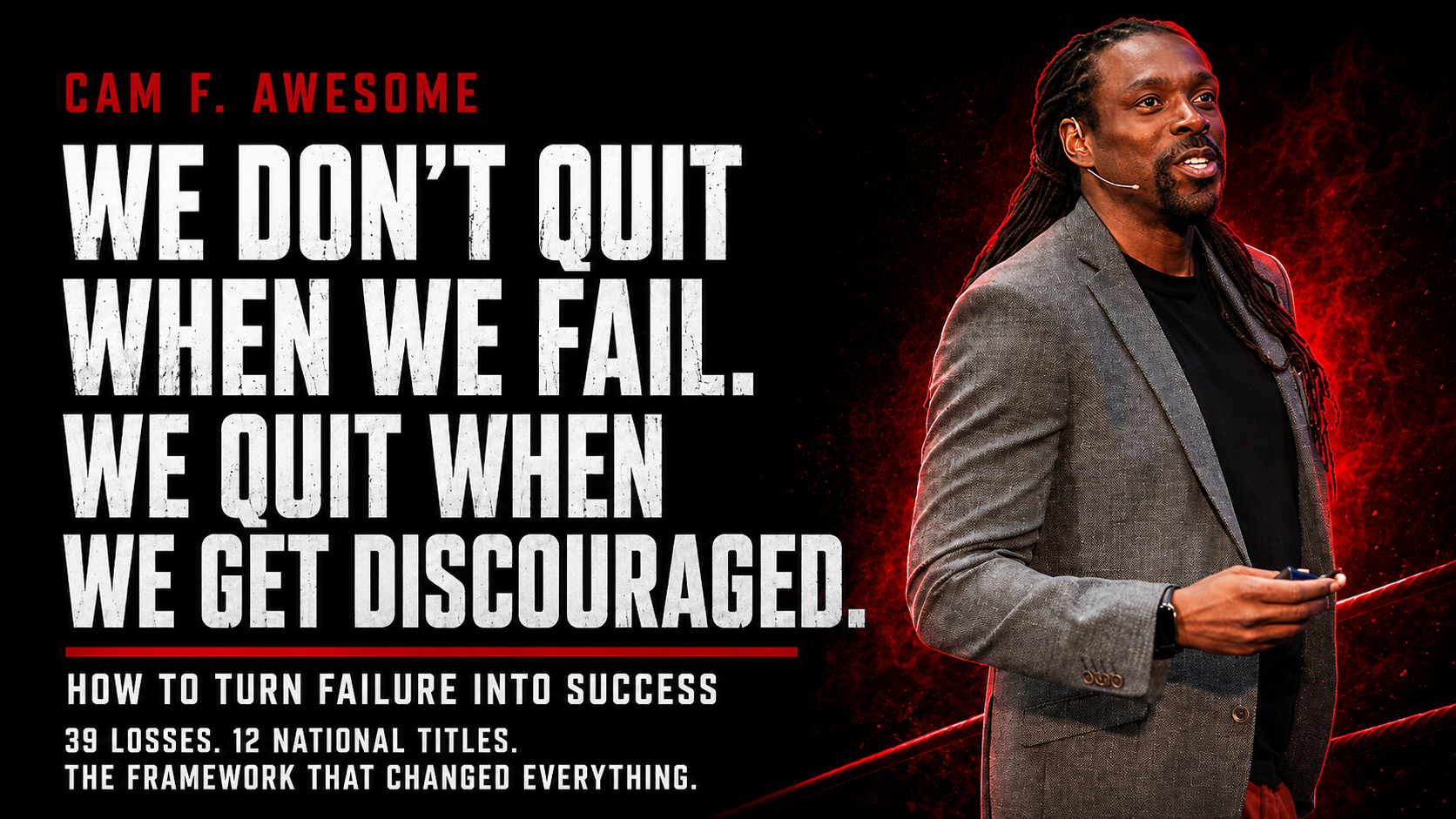
How do you turn failure into success? Not by avoiding failure, and not by pretending it does not hurt. You turn failure into success by changing the story you tell yourself after you fall short, because that story determines whether you get back up or stay down. My name is Cam F. Awesome. I am the winningest boxer in USA Boxing history, a 12-time National Champion, 3-time Olympic Trials Champion, former Captain of Team USA, and a keynote speaker featured in the Netflix documentary Counterpunch. I have 39 losses on my record. Every single one of them taught me something that my wins never could. And the framework I built from those losses, the Identity Loop, is what I use on stage with organizations across the country to show teams how failure is part of success when you know how to use it.
Here is what I learned, and how you can apply it starting tonight.
Why Learning From Failure Starts With How You Talk to Yourself
Most advice about learning from failure focuses on tactics. Analyze what went wrong. Make a plan. Try again. That is fine, but it skips the part that actually matters: what you say to yourself between the failure and the next attempt.
I know this because I lived the difference.
In elementary school, I was released from class at 2:50 every day, ten minutes before the other kids, because a bully in my class had slammed my head into a brick wall and sent me to the hospital with a concussion. The school's solution was to let me leave early so I could get home before he caught me. Every day, I walked through the parent pickup line, convinced every adult watching knew exactly why I was leaving. In my head, they were all thinking: "There goes the kid who gets beat up." They were not thinking that. They did not even notice. But I told myself that story so many times it stopped sounding like a story and started feeling like a fact.
I was afraid. I was a coward. I could not defend myself.
That story followed me to middle school, where I volunteered in the nurse's office during lunch to avoid the cafeteria. It followed me to ninth grade, where I lost my first fight to a girl in the first week of high school. I carried shame, fear, and anger through every hallway for years, and I never told anyone the full weight of what that cost me. I did not use the bathroom at school because I was afraid someone would walk in and corner me. I did not join conversations because I was terrified someone would bring up the fight. I stayed inside my house after school because the bully lived on the same block.
The story I told myself did not just describe my life. It designed my life. Every behavior I had, from hiding to avoiding eye contact to refusing to raise my hand, was a direct output of the identity I had built from that story.
That is the part most failure advice misses. It is not the failure that keeps you stuck. It is the story you tell yourself about what the failure means.
The Identity Loop: A Framework for Turning Failure Into Success
Years later, after I had gone from that scared kid to a national boxing champion and back down to a depressed, 60-pounds-heavier version of myself who could not stop the start-stop-quit cycle, I finally saw the pattern clearly enough to name it. I call it the Identity Loop, and it works like this:
Story creates Identity. Identity drives Behavior. Behavior confirms the original Story.
It runs on a loop, and it runs whether you are aware of it or not. Here is how it played out across three phases of my life.
The Coward Loop (Elementary School through High School) Story: "I am afraid. I am a coward. I cannot defend myself." Identity: Coward. Behavior: I hid from people. I avoided eye contact. I would not let anyone see me. Result: Every act of hiding confirmed the story that I was, in fact, a coward.
The Champion Loop (High School Boxing through 2012) Story: "I am unstoppable. I am the best. I am a champion." Identity: Champion. Behavior: I showed up early. I stayed late. I gave everything I had. I kept going when it was hard. Result: The championship behavior produced championship results, which confirmed the story.
The Failure Loop (2012 Suspension) Story: "I am an idiot. I am a fat loser. How did I get here?" Identity: Inconsistent person. Behavior: Start, stop, quit, repeat. Result: The inconsistency confirmed the story that I was broken.
The breakthrough was realizing the loop does not start with behavior. It starts with the story. If you try to change your behavior without changing the story underneath it, you end up white-knuckling your way through a few good days before falling back into the old pattern. But if you change the story first, the identity shifts, and the behavior follows.
If you want to map your own Identity Loop tonight, here is where to start: Write down who you believe you are right now. Then ask yourself who originally told you that, and whether you still believe them. Then write down who you want to become and the specific traits that person would carry. The gap between those two versions is your next Identity Loop waiting to be built.
How to Deal With Failure: Separate Your Output From Your Outcome
Here is the sentence I have built my entire career around: If you can fail without being discouraged, success becomes inevitable.
Most people hear the word "fail" and think the word itself is the problem. It is not. Failing is just accumulating data. A boxer with a hundred fights and a record of 5 wins and 95 losses has more experience than a boxer with 3 fights and a perfect record. If those two step into the ring, the experienced fighter wins. That is how powerful accumulated failure is. But you do not get those hundred fights if you let discouragement stop you at fight number six.
We do not quit when we fail. We quit when we get discouraged. And a lot of us get discouraged before we even start.
The tool I use to prevent discouragement is separating output from outcome. I cannot control the outcome. I cannot tell a judge which name to write down on a scorecard. But I can control my output: how hard I trained, how clean I ate, how well I slept, how disciplined I stayed, whether I gave everything I had.
After every fight, win or lose, I run a checklist:
Did I train as hard as I could?
Did I eat right and stay disciplined?
Did I sleep well and take care of my body?
Did I do everything in my power to win?
If the answer to all of those is yes, and I still lost, I do not punish myself. The effort did not match the result, and that happens. But I do not owe it to anyone to be mean to me because the scoreboard did not go my way.
This is not hypothetical. In 2015, I fought the number one boxer in the world at the Pan American Games on live ESPN. I gave him everything I had. They did not call my name. A Cuban fan slapped me in the face with a flag. And sixty seconds later, ESPN's Tony Collins put a microphone in front of me. I told the camera I thought I looked amazing. I called myself the Taylor Swift of boxing. I spoke to myself the exact same way I would have if I had won, because my value was never in the outcome. It was in the output. That clip looked strange to a lot of people, but it was not a performance. It was the result of years of practicing a specific internal dialogue.
If you do everything on your checklist and you still lose, you are not a failure. You are experienced. And experience, not talent, is what compounds.
How Failure Leads to Success: One Loss, 43 Wins
In 2010, the number one heavyweight in the world, Roberto Cammarelli from Italy, came to the United States to fight me in Reno, Nevada. He never hurt me, and I gave him a competitive fight. But he beat me clearly, and the way he did it was a revelation.
In the U.S., we throw short, powerful punches designed to hurt. Cammarelli looped his punches from outside my line of vision. They did not hurt, but they knocked me off balance like a matador working a bull. I had never seen anything like it. No one in my weight class in America had.
After the fight, most boxers would have said: "I lost to the best in the world. He is just better." That is a reasonable story. It is also a story that stops you from getting better.
The story I told myself instead: "I made that guy sweat. I belong at this level. He has 15 more years of experience on me, and I still pushed him. The only difference between us is time."
I went back to the gym and studied the film obsessively. I adopted the looping hook as my own weapon. I paired it with the check hook and the uppercut, and those became my signature combinations. When I returned to domestic competition, I carried myself as a world-level fighter, not just a national one. Other boxers had heard I pushed Cammarelli, and that changed how they saw me before we ever touched gloves.
That one loss produced a 43-fight win streak in the United States. One loss, 43 wins. That is an exchange rate I am willing to take every time. But you do not get those 43 wins if you are too discouraged to study the film the morning after the loss.
How to Overcome Failure: The Things That Take No Talent
Talent did not make me the winningest boxer in USA Boxing history. I retired with more wins than any other boxer in the program's history, and I did it by doing the things that take no talent. I call it the TNT list, and every item on it is fully within your control regardless of your natural ability.
Be on time. Be prepared. Bring energy. Stay coachable. Finish what you started. Be patient. Actually care. Be enthusiastic. Build team morale. Listen. Be a good mentor. Show up every day. Be consistent. Own your mistakes. Follow through. Be kind. Show gratitude. Be curious. Have integrity. Keep your word. Respond instead of reacting. Be accountable. Pay attention to details. Celebrate other people's success. Ask good questions. Help without being asked. Smile. Be organized.
None of those require talent. All of them require discipline. And collectively, they produce something that looks like talent from the outside but is actually just relentless consistency.
The one I struggle with most is paying attention to details. I know this because in 2012, I became the first boxer in United States history to be suspended and removed from the Olympic team for not filling out paperwork. I had won the Olympic Trials. I was the number one heavyweight in the country. And I lost everything because I used a sponsor's business address in Kansas City as my home address for drug testing, never checked the mail, and missed three random tests I never knew were scheduled. One of those missed tests happened while I was out of the country competing in the World Championships. It did not matter. Three missed tests equaled a positive test under the rules. I was suspended, and the boxer I had beaten six consecutive times took my spot.
That failure cost me the Olympics. But it also taught me the lesson I now carry as a core part of my identity: I cross my T's and dot my I's. A small detail can take everything away, and I will never let that happen again.
Failure Is Part of Success: The Real Story Behind My Comeback
After the suspension, I lost my sponsorship, my housing, and my sense of who I was. I crashed on a friend's couch in Los Angeles. I posted ads on Craigslist offering boxing workouts for $25 an hour. I was drinking heavily, rinsing my mouth with mouthwash before training sessions. I gained 60 pounds. I stood in front of a mirror one day and said: "You idiot. You fat loser. How did we get here?"
That stretch lasted about eight months. And what broke it was not inspirational. I lost a bet.
One of my clients, Bill Mackey, wagered me on a boxing match. I lost, and the terms were a 28-day vegan challenge designed by his wife Amy, a vegan dietitian. The diet also meant sobriety. For 28 days, I could not drink away my problems. I just had to sit in the discomfort.
I lost 32 pounds. But the bigger change was community. Bill and Amy showed up the morning after I lost the bet. They took me grocery shopping. They bought me a knife, pots, and pans because my apartment had none. They taught me how to read food labels. Every Sunday they came over and we meal-prepped for the week. Other clients started joining. It became a weekly gathering they called the Sunday Cookathon. The food mattered, but the people mattered more.
That community is what pulled me out. I can talk about self-talk and identity loops all day, but the honest truth is that I needed other people to show up for me before I could show up for myself again. And once they did, I legally changed my last name to Awesome, threw an "after birthday party" for over a hundred people to publicly declare the death of the old me and the birth of the new me, and went back to boxing with three identity commitments: I am resilient. I am thorough. I am good under pressure.
I made the commitment public because private resolutions had not worked. When you make a proclamation in front of a hundred people and then show up to nationals two months later, you cannot afford a half-hearted effort. The public accountability is what gave the new identity teeth. Netflix heard about it and followed me with a seven-person camera crew for three years, filming what became the documentary Counterpunch, released in 2017. The cameras added another layer of accountability. Every day, I had to be the person I said I was, because it was being recorded.
I won nationals in 2013, 2014, and 2015. I won the 2016 Olympic Trials. And even though I did not ultimately compete in the Olympics due to circumstances beyond my control, the framework held. The story I told myself, the identity I built, and the behaviors that followed carried me further than talent ever could have.
Frequently Asked Questions
Why is failure the key to success?
Failure is the key to success because it is the fastest way to accumulate experience, and experience is what separates people who consistently perform from people who occasionally get lucky. A boxer with a hundred fights and a mediocre record will outperform a boxer with three fights and a perfect record, because the experienced fighter has encountered and adapted to situations the undefeated fighter has never seen. Failure becomes destructive only when it produces discouragement, which is what makes people quit. The failure itself is just data.
How do you deal with failure without getting discouraged?
Separate your output from your outcome. You cannot control results, but you can control effort, preparation, discipline, and attitude. After any setback, run a simple checklist: Did I prepare fully? Did I give my best effort? Did I stay disciplined? If the answer is yes and the result still was not what you wanted, the gap is not a reflection of your worth. It is a reflection of variables outside your control. Protect your internal dialogue in those moments. The way you talk to yourself after falling short determines who you become next.
What is the Identity Loop?
The Identity Loop is a framework developed by keynote speaker Cam F. Awesome based on his experience as the winningest boxer in USA Boxing history. It describes a cycle: the story you tell yourself creates an identity, that identity drives your behavior, and that behavior produces results that confirm the original story. The loop runs constantly, whether you are aware of it or not. To change your results, start by changing the story, which shifts your identity, which naturally changes your behavior.
Can failure actually make you more successful than winning?
Yes, and the evidence is measurable. After losing to the number one heavyweight in the world in 2010, Cam F. Awesome studied the film, adopted his opponent's technique, and used that single loss to fuel a 43-fight win streak in the United States. His 39 career losses each taught him something specific: the city, the opponent, what he did wrong, and what to change. His wins did not provide that same level of instruction. He retired as the most winning boxer in USA Boxing history not because he was undefeated, but because he was never discouraged.
How do you build a new identity after a major failure?
Start by defining the traits of the person you want to become, then make that identity public. Cam F. Awesome legally changed his last name to Awesome and threw a public party to declare the transition. Most people do not need to go that far. A simpler version: tell the people around you who you are becoming, then show up consistently as that person until they start holding you to it. If your current environment reinforces your old identity, expand your circle. Introduce yourself to new people as the version of yourself you are building, and be consistent enough that they never know the old version.
Your Story Determines Your Next Move
Turning failure into success is not about positive thinking or pretending losses do not sting. It is about controlling the one variable that shapes everything else: the story you tell yourself. That story creates your identity. Your identity drives your behavior. And your behavior produces the results that either keep you stuck or carry you forward.
I built the Identity Loop from 39 losses, a suspension that cost me the Olympics, 60 pounds of weight gain, and a comeback that was documented by Netflix. The framework works because it is built on something I tested with my own life for over a decade.
Bring the Identity Loop to Your Next Conference
Cam F. Awesome delivers his keynote Becoming Awesome to corporate conferences, association events, and leadership summits nationwide. If your team is stuck in a cycle of playing it safe, avoiding risk, or letting setbacks kill momentum, this keynote gives them a framework for building resilience, owning their internal dialogue, and performing at their highest level, especially when things do not go as planned.