
Mental Toughness Habits That Built a National Champion
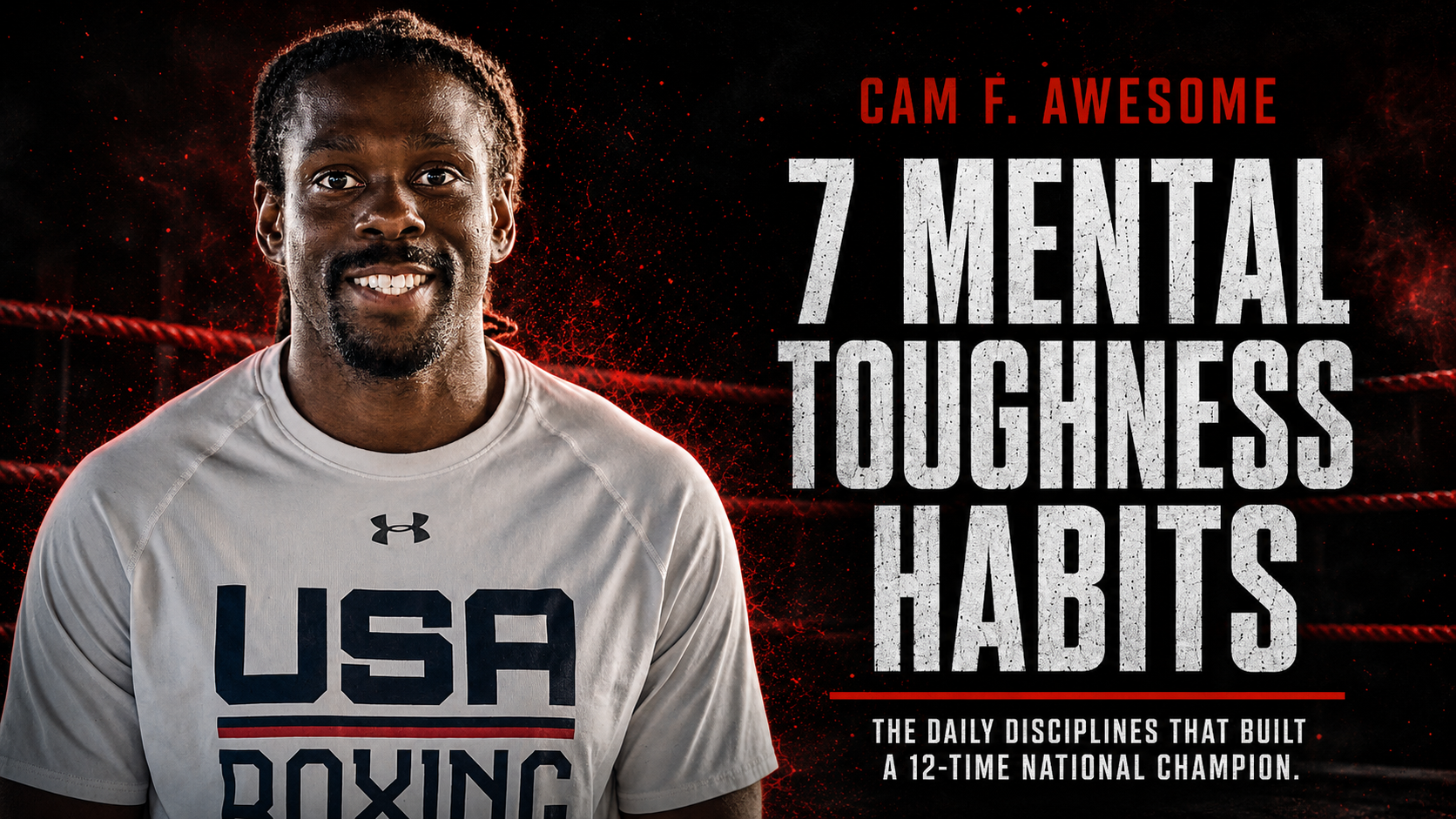
What are the mental toughness habits that actually work? The ones you can still run on a bad day. For me it came down to doing the things I didn't feel like doing, competing with whoever was best in the room, questioning stuff nobody else questioned, and talking to myself like I belonged before the results said I did. Here are the habits I actually used, and the one piece of "tough" advice I think backfires on most people.
I'm Cam F. Awesome. I retired from boxing with more wins than any boxer in USA Boxing history, 12 national titles, and a run as Team USA Boxing captain, and Netflix followed me around for three years for a documentary called Counterpunch. But I didn't get there on talent. I'm the kid who got beat up in ninth grade and didn't make a single team until I was 17. What I had was a handful of habits I could repeat when nobody was watching. Here are seven of them, with the office version of each, because you don't need a boxing gym to run any of this.
1. Do the Things You Don't Feel Like Doing
The first habit is the plainest one: being able to do things I don't feel like doing. Once I could conquer that, honestly, it made my whole life a lot easier.
This is the one underneath all the others. If I was sad, I'd just have to do the thing sad. If I was hungry, I'd do it hungry. I never let my emotions dictate my to-do list. I took an almost sociopathic way of thinking toward my goal, no emotions involved, and I just did the boring fundamentals until they became automatic.
The office version: Split the decision to do the work from how you feel about doing it. The report gets written whether or not today's a good day. Motivation is a mood. The work is a promise.
2. Compete With Whoever Is Best in the Room
Competitiveness is one of the most important habits I've got, and I use it like a measuring stick. A lot of times you don't know what pace you should be running at. So I find out whoever the best is, and that's where I set my standard for hard work. Once I catch up to that person, I find someone else to compete with.
There's always someone I can catch up to, and always someone I can work hard enough to reach. That's what keeps the standard from slipping.
The office version: Find the person making the most sales, or doing the best work, and study what actually sets them apart. Are they spending more time on outbound? On inbound? Do they care more? Do they catch the small details? Figure out that one thing and do it better and more efficiently, and obsess over it. Once you catch up to that person, find a new one.
3. Question Everything, Even the Traditions
Here's a habit that got me some strange looks: I questioned everything I did and everything I was taught. I realized I can't get where I'm going by doing what everybody else is doing. I had to stray from the pack to give myself an advantage. And I believe a lot of tradition just holds you back.
My example is the speed bag. I refused to hit it. People only hit the speed bag because it's in every gym and it's got this reputation with boxing, but it doesn't have real function. Your footwork's not in it, it's not really hand-eye coordination, you can hit it with your eyes closed, and it's not a good way to work your shoulders. The average boxer hits the speed bag four rounds a day, works out around 250 days a year, and that's a thousand rounds, which works out to about 67 hours. If I had an extra 67 hours a year, why wouldn't I put that into my jab? That's the most important punch. Sometimes that meant standing up to coaches who did it the old way because that's what they knew. Back in Ali's day they thought water made you weak, too.
The office version: Look for the thing in your workplace that's antiquated, that people have done so long nobody questions it anymore. When you question what's no longer being asked, that's where innovation comes from. Ask yourself what innovation would look like in your role.
4. Choose Discomfort on Purpose
This is a habit most people run backwards. I didn't wait for hard things to show up. I went and found them. When I was tired, that's when I focused on working even harder. I sparred boxers who were better than me. I always chose the most difficult route, and I chose discomfort instead of avoiding it.
The reason is simple, and it holds up: if I was always uncomfortable, then when discomfort got forced on me, it was my comfort zone. Once you do difficult things, the normal things become easy.
The office version: Take the assignment that stretches you before you feel ready. Have the hard conversation instead of waiting until you can't avoid it. Difficult things only turn easy after you've done enough of them.
5. Parent Yourself
I call this self-parenting, and it might be the most useful reframe I've got. When we're kids, our parents tell us to put the phone away and do the work. As adults, nobody parents us but ourselves. So I learned to parent myself and be disciplined.
I treated preparation like a responsibility, because that's the one thing I have control of, and I treated it like a job. My non-negotiables were promises I made to myself. If I said I was going to do something, that was a promise, and if I can't keep a promise to myself, I can't keep a promise to anyone.
The office version: Be the one people can rely on. Show up on time, be a leader, do the simple things until you can do them in your sleep and you're known as the expert. Then demand your value. Don't do all that hard work in secret and assume people will just hand you something before you ask. Ask for the promotion. Step up for the raise. Take the leadership role, show what you can do, and then ask for the compensation behind it. Know your value.
6. Extract Value From Everyone
A quieter habit, but I lean on it hard: I had to be able to extract value from everyone. I'd learn what not to do from some people and what to do from others. There were coaches who spewed a lot of nonsense, but I was able to ignore 97 percent of what they said and take the 3 percent that applied to me.
There are a lot of people out there willing to give advice, and a lot of the time that advice doesn't line up with your life or the way you want to do things. So take the lessons that do fit what you're doing, and leave the rest.
The office version: Stay coachable without swallowing everything. Trust the people who've earned your trust, grow and adjust when the feedback is real, and quietly let the rest go. Being selective isn't the same as being closed off.
7. Talk to Yourself Like You Belong
The last habit is identity, and it's the one that ties the whole thing together. I talked to myself like I belonged before I had the record to back it up. I made myself the hero in my own stories and I identified as the type of person who's resilient. Then I let my habits reinforce who I already believed I was, like seeing myself as the best boxer in the country before I actually was.
That's what I call the Identity Loop: you tell yourself a story, that story creates an identity, that identity drives a behavior, and that behavior loops back to prove the original story true. In high school I told myself for three hours a day that I was a champion, so I showed up early, stayed late, and gave everything, because that's what a champion does. The habits followed the story, not the other way around.
The office version: Decide who you are, then let your daily behavior protect that standard. You don't wait to feel like a leader before you act like one. You claim the identity and let the actions catch up.
Which Mental Toughness Habit Was Hardest to Build?
Honestly, resilience, by a lot. Resilience looks good when you bounce back and win the comeback fight and everyone's watching. But the hard part is when no one's watching, when it seems like nobody cares, when you hear silence and then you hear that voice in your head wondering if this is even worth the attempt.
That voice creeps in constantly. I've stumbled a few times over the years. The hard part is fighting that voice, looking for the bright side, and finding ways not to be discouraged, which is really my whole thing: if you can fail without being discouraged, success becomes inevitable.
Which Single Habit Do I Credit Most?
If I have to pick one, it's doing the things that take no talent, by far. Showing up early, staying late, giving full effort, being kind, having enthusiasm. That's my TNT list, things that take no talent.
The reason is those are all the things I can actually control. If I obsess over them, I become great, and I gain experience whether I win or lose. Growing up, everyone wanted to be Iverson. Iverson's a once-in-a-generation talent, and most of us can't be that. But you can be Paul Pierce. Ask people what's special about Paul Pierce, and it's not the dunking or the crossover, it's that he does the things that take no talent, and he's got a championship and a Finals MVP. I retired with 39 losses and more wins than any boxer in USA Boxing history, and I didn't do it by being undefeated or being talented. I did it with consistency.
Frequently Asked Questions
What are the best mental toughness habits?
The ones that last are behavioral, not emotional: doing what you don't feel like doing, competing against the best person around you, choosing discomfort on purpose, parenting yourself through non-negotiables, and talking to yourself like you belong. I credit those habits, not talent, for a record-setting boxing career.
How do you build mental toughness at work?
Run the gym versions in the office. Compete with the top performer on your team and study what sets them apart, question the processes nobody questions anymore, take the stretch assignment before you feel ready, and treat your own preparation like a job you can't skip. Then demand the value your work has earned.
What toughness habit do people think works but actually backfires?
Waiting to feel motivated before you start. I did the opposite: I never let my emotions dictate my to-do list. If your discipline depends on your mood, it falls apart on the days you need it most, so I did the work sad, tired, or hungry, and let the mood catch up.
Is mental toughness something you're born with?
I don't think so. The habits I credit most, especially doing the things that take no talent, don't take any natural gift at all. They come down to consistency and showing up, and anyone can choose to do that.
Bring These Mental Toughness Habits to Your Next Conference
I deliver this message to corporate conferences, sales kickoffs, and association events. If your team keeps waiting to feel ready before they do the hard thing, this keynote hands them a set of habits that build the real kind of toughness, the kind that survives a bad quarter and not just a good one.