
Why Failure Leads to Success
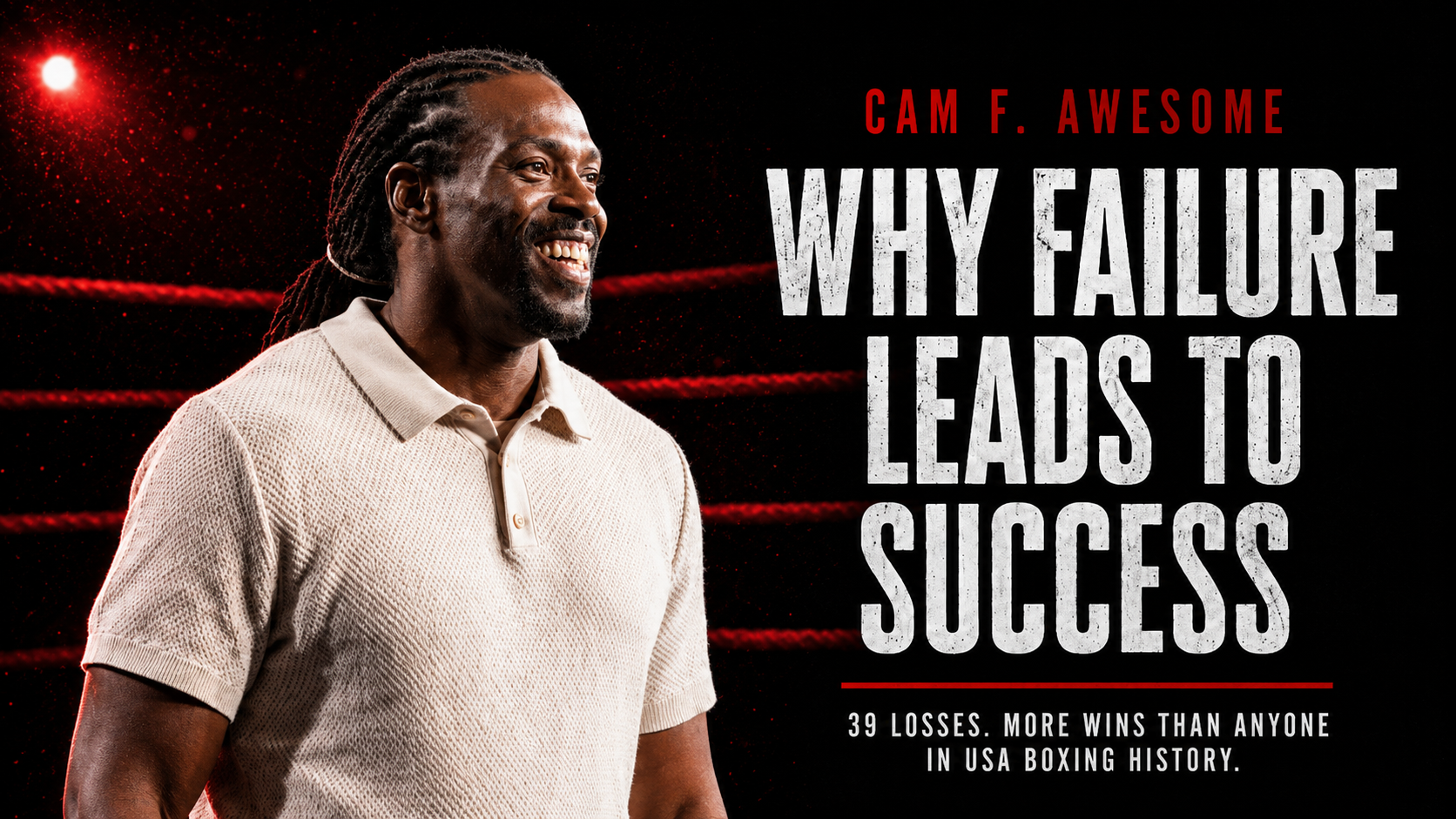
Why does failure lead to success? Here is my honest answer: it doesn't. Not directly. Experience leads to success, and failure is one of the greatest ways to gain experience. Most people only take action when they think it will lead to success, so they avoid the exact experiences that would eventually get them there.
I'm Cam F. Awesome, a keynote speaker and the winningest boxer in USA Boxing history. I won 12 national championships, captained Team USA, and Netflix followed me for three years for the documentary CounterPunch. I also lost 39 times. I can tell you the city, the opponent, and the exact mistake behind every one of those losses. I cannot do that for most of my wins.
In this post I'll show you the mechanism most people miss: why failure only converts into success when you treat it as experience, what failing productively actually looks like, and the exact identity move that keeps a loss from turning into shame.
Failure Doesn't Lead to Success. Experience Does.
If you strip my whole career down to one principle, it's this: experience leads to success, and failure is the fastest way to gain experience.
Taking action is how you gain experience. But a lot of us only take action if we think it's going to lead to success, so we avoid the reps entirely, because the reps might lead to failure. If you can accept the outcome either way, failure or success, and continue to do the thing, you gain experience. And experience is what eventually wins.
Here is what that looked like in my speaking career. When I first started speaking, I could not hold a room. I was nervous. My storytelling wasn't good. The talks didn't go well, and I would get back to my car afterward thinking, man, that was rough. But I understood something: I could only be so bad for so long. So I lived in a van and spoke at hundreds of schools, stacking experience.
In May 2026, I delivered the undergraduate commencement keynote for Southern Connecticut State University's Class of 2026 at Total Mortgage Arena in Bridgeport, in front of more than 10,000 people. I wasn't nervous. Everything that could go wrong on a stage had already gone wrong on some smaller stage, and I had learned to handle all of it. That one talk led directly to a wave of new speaking engagements.
The failures didn't cause that success. The experience did. The failures were just the tuition.
Failing Productively: The Loss That Won Me the 2012 Olympic Trials
There is a difference between failing and failing productively, and the difference comes down to the story you tell yourself afterward.
If you fail and you beat yourself up, belittle yourself, shrink, and punish yourself, the loss has no value. But if you lose and you're totally okay with it, that has no value either. Failing productively means using the anger and the sadness as fuel, finding what the loss taught you, and getting better for next time. You shouldn't want to fail. You deal with failing. It's part of the game. But you shouldn't be okay with it either. It should fuel you.
Here is the clearest example from my boxing career. At the 2011 USA Boxing National Championships, I got complacent. I had been winning a lot, I had already qualified for the Olympic Trials three times, and I basically showed up to coast. I lost to a fighter named LaRon Mitchell. It was my first loss in a long time, and I was furious about it.
The next tournament on the calendar was the Olympic Trials, and if we both advanced far enough, I would have to face him again. So I got in the best shape of my life to that point. More disciplined, more focused, more prepared than I ever would have been if I had won that fight. The Trials were double elimination. I fought LaRon Mitchell twice, beat him twice, and the second win came in the finals to take the 2012 U.S. Olympic Team Trials.
I'm grateful I lost to him before the Trials. That loss arrived at exactly the right time, exposed my complacency, and forced me into the championship mindset I needed when it actually counted. A win in 2011 would have fed the complacency instead.
Why You Won't Learn From Failure in the Moment
Here is something I want to be honest about, because most advice on learning from failure skips it: you do not learn from a failure in the moment it happens.
That moment is miserable. It's uncomfortable. There is no room for lessons in that moment. You just have to deal with it. When I lose, I'm frustrated and I'm angry, and it takes time for my brain to calm down before I can see what the loss taught me. The lessons come after the pain starts to fade, not during it.
What helps in the meantime is being objective about the math. If I lose one out of every ten times, then after 100 fights I'm going to have 90 wins. That is a lot of wins, if I'm being objective about it. The loss in front of you feels enormous. The record around it tells the truth.
So if you just failed at something and you can't find the lesson yet, you are not doing it wrong. Give it time. The lesson will still be there when the sting isn't.
How to Keep Failure From Turning Into Shame
The move that keeps failure from becoming shame is an identity move, and I make it before the failure ever happens: I identify as the type of person who fails at things.
That sounds backwards, so let me explain. In my friend group, I'm the guy who tries everything. The guy who lives in a van. The guy who will try the vegan thing, drive to a small town just to see its festival, start the business, ask the question, fall on his face and laugh about it. People expect that from me. There is no shame in my game, because taking the chance is what I set out to do. I would be ashamed if I didn't take a chance.
Shame comes from identity. If you build an identity as the perfect person who never fails and has it all figured out, you confine yourself to only doing things that protect that identity. That is not taking chances. That is playing it safe and staying where you are. But if you identify as someone who takes big risks, fails, gets back up, and rolls with the punches, then it would actually be risking your identity not to take the risk.
Think about SpaceX. A rocket explodes and everyone laughs. But the rockets need to fail for the engineers to learn how much pressure they can take and what they are capable of. The failure is part of the test plan. If your goal is big enough that failure is part of the process, you stop caring when your rocket explodes.
This is the same pattern I call the Identity Loop: the story you tell yourself creates an identity, that identity drives a behavior, and the behavior works to prove the original story true. Tell yourself you are the person who takes chances, and taking chances stops being shameful. It becomes proof of who you are.
Frequently Asked Questions
Does failure lead to success?
Not directly. Experience leads to success, and failure is one of the fastest ways to gain experience. The people who succeed are not the ones who avoid failure. They are the ones who keep taking action, accept the outcome either way, and stack experience until success becomes inevitable.
What is the difference between failing and failing productively?
The story you tell yourself afterward. Beating yourself up after a loss produces nothing, and being totally fine with a loss produces nothing either. Failing productively means using the frustration as fuel and identifying exactly what went wrong, the way Cam F. Awesome used a 2011 loss to LaRon Mitchell to prepare for and win the 2012 U.S. Olympic Team Trials.
How do you stop failure from turning into shame?
Change what you identify as before you take the risk. Shame protects an identity built on never failing. If you identify instead as the type of person who takes big chances, failing becomes evidence that you are living up to your identity, and it would feel riskier not to try.
Why is experience more important than a winning record?
In boxing, if one fighter has 3 fights and another has 100, you bet on the fighter with 100, even if their record is 5 wins and 95 losses. That is how powerful experience is. Losses build experience just as much as wins do, which is why a long record that includes failures usually beats a short, perfect one.
Conclusion
Failure leads to success only when you convert it into experience, and the conversion happens in the story you tell yourself after the loss. That is the heart of the Identity Loop, and it is the reason I say that if you can fail without being discouraged, success becomes inevitable. I retired with more wins than any boxer in USA Boxing history, and I did not get there by being undefeated. I got there with 39 losses and a decision about what each one meant.
Bring Failing Without Being Discouraged to Your Next Conference
Cam F. Awesome delivers this keynote to corporate conferences, sales kickoffs, leadership events, and association meetings. If your team hesitates to take risks because they are afraid to fail, this keynote gives them a practical way to convert setbacks into experience and experience into results.
Or call 913-766-3965 or email kelly@upsidespeakers.com to book Cam for your next event.